
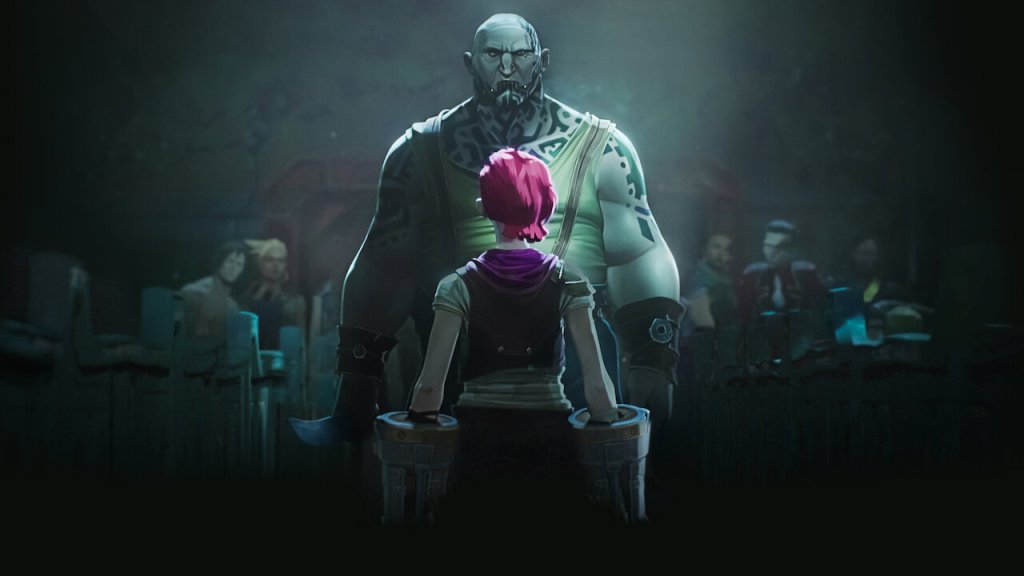
*This image is taken from Netflix, all credit goes to them and the show’s creators for the show Arcane. This article will contain major spoilers for Arcane.*
The action genre in television and film is simultaneously one of the most beloved and oversaturated genres in those mediums. Works that have fallen under the umbrella of action have been praised for delivering thrilling and interesting stories, but have been equally criticized for being soulless or simply boring. This contrast can be seen in many forms, such as how Marvel Studios’ recent movies and shows are viewed by many as much worse in quality than the films of phases 1–4. So, what’s the separator? What makes a good story in the action genre, and what makes a bad one? To understand that, it is crucial to examine some of the most highly regarded works in the genre. One such work is “Arcane”, a show based on the game “League of Legends,” which has risen to be one of the best-rated products on Netflix. Its exemplary writing can make it clear to anyone how to write in the action genre.
Characters
The foundation of any action section in storytelling is the two or more parties actually battling, and since the action genre is built around action sections, the genre itself is heavily reliant on characters to produce quality storytelling. This stretches far beyond a character’s skills in a fight, though; everything from motivations to goals plays into what makes a good or functional character in the action genre. Of course, this is much easier to talk about in theory than to execute in practice, but Arcane just so happens to provide a great example of what good character writing looks like in the action genre.
Vi and Action Protagonists
The protagonist of Arcane is Violet, or Vi, as she is more often called, and the way she is written reveals a genius way to craft an action protagonist. From the first episode to the last, Vi is shown to be a fighter, always chasing her goals and being willing to battle with anybody who might be in the way of them. This part of her never changes, and since she always fights for something depicted as good, the audience can always root for her because of that admirable determination. That immediately checks off the box of making an action protagonist that people want to win their fights, a trait that many other protagonists in the genre (Rocky, Iron Man, Miles Morales, etc.) thrive off of in their narratives. However, the writers of Arcane didn’t stop there; they also made sure to tie her character heavily to one of the show’s themes, that theme being progress. One of the biggest messages Arcane conveys is that progress should be made cautiously, and it explains why through the many tragic events that happen throughout the show as a consequence of people moving forward overzealously. This is a mistake that Violet, perhaps more than anyone, makes over and over again. That fighter aspect of her personality makes her very straightforward, barreling towards her ambitions but often never thinking of all the important factors involved in those ambitions. Instances of this include her failure to get information about Jinx out of Sevika in their first fight, pushing away Jayce through her lack of empathy for the death of a child at the Shimmer Plant, and failing to truly acknowledge that her sister will never go back to being who she once was in the finale of Arcane Season 1. This makes her character feel very interesting and meaningful to the story; Vi is a complicated figure within the narrative, not just a vehicle through it. Not every action protagonist does this, and in fact, many action titles struggle with making a solid theme, but Vi’s writing is no such example of that. Her connection to the thematic meaning behind Arcane adds a wealth of emotion and intrigue to her character, the same way that connection made characters like Rocky Balboa or Miles Morales better within their narratives.
Silco and Action Antagonists
Silco is the main antagonist of Arcane and falls under the archetype of physically weak but intelligent action villains. Typically, those types of characters challenge a strong protagonist mentally, testing the strength of their beliefs and ideals. This is a norm Silco does not fall into, as he and Vi hardly even interact with each other throughout Arcane, and Silco in particular rarely ever takes Vi into account when planning. However, his character stays interesting and relevant to the plot because of his goal, which is to make Piltover’s marginalized undercity an independent nation. His drive to accomplish that puts the world in a state where many battles will occur, meaning that while he may never fight someone himself, he still heavily contributes to the action of the show nonetheless. Furthermore, his calm and collected personality does well to contrast with some of the louder characters in the show (like Vi), giving the audience a bit of a mental rest from the action and noise to craft a more understandable plot. Silco’s demeanor is the key to Arcane not falling into the pacing issue that many action titles have, where so much is happening so fast that it’s easy to miss important character work and dialogue (this is an issue the movie Black Widow had, and the Netflix show Ultraman struggled with this at times in its first season). Finally, his relationships with members of the cast like Vander or Jinx help flesh him out and put some emotion behind his character, making him more than just a “mustache-twirling bad guy”. He facilitates Arcane’s action while also providing something interesting and unique in its quieter moments, adding plenty to the show and becoming a swell antagonist in the process.
Plot
Characters are only half the storytelling equation, with a narrative’s plot being the other portion. Something has to cause action scenes to occur, as action scenes built from thin air are often the low points of their narratives, so having an understandable and interesting plot is a big part of the action genre. Arcane masterfully executed the two things that make up the plot of a narrative, and looking into how it did so reveals some of the proper things to do when writing an action plot.
Series of Events
The skeleton of the story—that is what a series of events is. It is the main thing that defines a plot and is the key to making that plot of high quality. Arcane’s way of creating a series of events is nothing groundbreaking, even within the action genre, but it does always keep the narrative understandable and the character’s actions mostly logical. The show is told almost entirely in chronological order, with any flashbacks usually being displayed at the start of any given episode, meaning that the earliest events in that episode are always the first to be shown. This order of storytelling is concise, never overwhelming or confusing viewers. In addition to that, Arcane’s writers made sure to include more than just action segments in the show, allowing audiences to tap into different emotions during their viewing. Moments more akin to a drama title are often the precursors to action scenes; the thought-provoking nature of the former creates mental engagement to support the sheer awe of the latter. These two things are further broken up by the occasional comedy bit, which does wonders to improve the entertainment factor of the show and allows viewers to just have a little fun. In short, Arcane’s series of events is told extremely effectively through a concise order of storytelling and the use of types of narrative segments that support all the other ones present in the show.
Theme
The greatest stories ever told all have something in common: a powerfully presented and relevant theme. Incorporating themes into a narrative’s plot adds an amount of emotion and beauty to the story that is impossible to replicate using anything else. Arcane’s writers clearly understood that during the making of the show, as Arcane actually has an array of strong themes that audiences can ponder and learn from. The one it focuses on most of all is progress, both in a person’s life and in technological advancement.
Personal progress is seen as a good thing within Arcane, so long as the characters making progress don’t do so without fully considering what those changes could mean. Though Vi is an example of overzealous progress within the story’s world, her personal development of letting go of some of the resentment she holds towards people living on the topside of Piltover is a purely positive change. She is able to get access to allies and equipment she couldn’t have gotten otherwise, showing how trying to progress away from hatred helps one achieve their goals. On the flip side, Heimmerdinger is entirely static in his characterization during the first season, and this is done intentionally by the writers. His being so stalwart in his beliefs causes him to lose power in Piltover, even if there was a good reason for him to believe them. He displays that personal stagnation reflects badly on people, hurting their image and pushing them further from their ambition.
Technological advancement in Arcane is a mixed bag, both good and terrible in its many aspects. Throughout Arcane, its benefits are constantly seen. Hexgates creating easier trade routes, a Hexcore that could heal disabilities—there’s a lot to like about what Hextech does. The technological advancement it provides the characters benefits them greatly, but that same technology is also the cause of the show’s conflict. Its potential to create weaponry and other destructive items makes it as much of a danger to Piltover as it is beneficial to the city. Through Arcane’s depiction of Hextech, it is made clear that technology is something that should be used and created with care, lest the consequences be dire upon using it. This paragraph is just the tip of Arcane’s thematic iceberg, but it is obvious when watching the show the wealth of emotion and intrigue its themes create in the narrative.
Fight Scenes
While they may be a bit detached from other parts of storytelling, fight scenes are the lifeblood of the action genre. Every title that falls into the genre puts a significant amount of focus on them, and Arcane is no exception. There’s an action scene in almost all of its nine episodes, and these scenes work because of context and choreography. By looking at how these two inextricable aspects of fight scenes are handled in Arcane, it becomes much clearer how to make a good fight scene.
Context
The context of a fight covers everything from who viewers want to win to why characters are fighting at all. While context is very much a result of character work and plot progression, it is certainly at the heart of any fight scene. Arcane understands this truth, and as such, it puts layers of context behind any given action segment it contains. A perfect example of it doing so lies in what many consider to be the series’ best action scene: the battle between Ekko and Jinx in episode seven. This ultimately quick encounter begins with a layer of context, as both parties have known each other since childhood, but circumstances and change have driven them to stand against each other. In addition to that, this battle is contrasted simultaneously with a stylized flashback of a game the two played when they were children, which the fight itself is a more lethal recreation of. The context this puts on the encounter itself turns it from “just another fight” to a tragic moment between former friends, displaying the results of all the ways they both changed throughout the years to get to this point. That is the power of context. It is the key that turns simple action into active storytelling, and Arcane is just another example of its impact.
Choreography
Of course, a fight scene isn’t a fight scene if people aren’t actually fighting. Arcane uses expert fight choreography throughout its runtime to make a thoroughly interesting visual spectacle and deliver a bit of visual storytelling, both of which elevate the series to stratospheric heights in terms of quality. Since it is a fantasy title, most of the action scenes in the show contain fictitious weapons or equipment, meaning the choreography of those scenes is often not based on real-life martial arts or fighting styles. Arcane is able to thrive in spite of that limitation through more stylized visuals in battle and camera work that expertly expresses pace and scale. For instance, the climax of Arcane’s second act (episode 6) features the characters Jinx and Vi fighting an undercity gang known as the Firelights to end the episode. The Firelight’s flying boards were the case of fictitious equipment in this scene, but instead of hindering fight choreography, they only elevate it. The entire encounter is practically framed around the boards and the people using them, with swooping camera angles and wide shots of the Firelights swarming around Vi and Jinx. The beautiful green light the boards give off is both a joy to see and makes the incredibly fast pace the equipment sets easy to follow. This is combined well with the more human aspects of the fight, such as Vi’s brawling and Jinx’s use of a minigun, to make a kinetic and awe-inspiring fight. Vi’s fist fighting is given this snappy and powerful feel to it through an extremely brief white screen effect following her punches, and the pink bullets Jinx fires rain across the battlefield for the entire fight, being framed more as approaching monsters than ammunition to add a new element to the scene. The way Jinx chaotically sprays her minigun across the battlefield also puts some visual storytelling into the fight, as the audience and Vi can see how much she’s changed since act one through that behavior. This is just a snippet of the fight choreography in Arcane, but Vi and Jinx vs. The Firelights details the visual effects and camera work the show uses to make incredible fight scenes. These are techniques any work of action can use to benefit its most vital scenes.
In sum, Arcane is a model of how to write and create spectacle in the action genre. Its characters serve their roles and more, with everyone contributing to the action, creating context for battles, pushing the plot forward organically, etc. The plot itself has a series of events that flow extremely well, with themes that are interesting and add so much depth to the narrative. Finally, its fight scenes are top-notch, filled to the brim with understandable context behind battles and excellent choreography. If any writer wants to better understand just how incredible the action genre can be and how they can create another great story in that category of storytelling, they’d be doing themselves a service by watching Arcane.
 Entertainment Analytical