
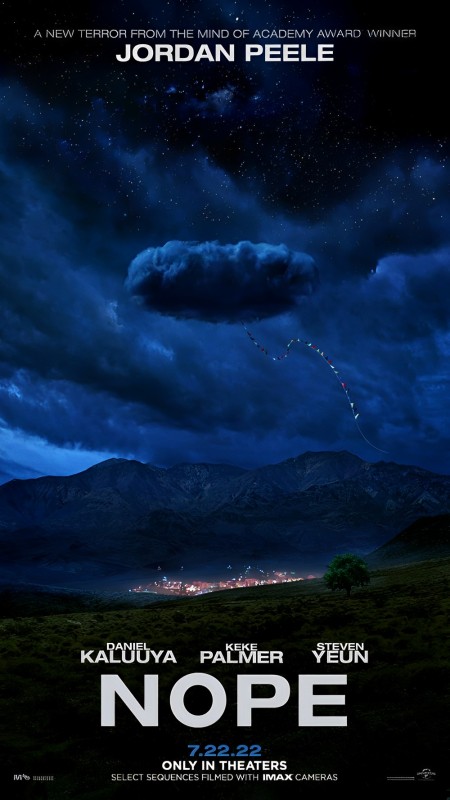
*Contains spoilers for Nope. Image taken from IMDb’s page on Nope*
Jordan Peele’s “Nope” is a fantastic movie, and much like any great film, there are a number of reasons for its high quality. Great acting, cinematography, character writing, concept—all of these things and more go into making Nope the masterwork that it is. Truthfully, all of those qualities can contribute to the success of any movie, but what makes this case special is how they’re applied. Every aspect of Nope serves as a kind of glue, holding the thematic elements of the film together and, in turn, creating something much greater than the sum of its parts. Those thematic elements all tie back to the concept of spectacle, and by seeing how Nope portrays spectacle, an incredibly important message can be deciphered.
What is Spectacle?
According to Oxford Languages, a spectacle is “an event or scene regarded in terms of its visual impact.” Examples of the term include things like the Seven Wonders of the World or many television series, and through those instances, the definition really takes form. Spectacles aren’t necessarily good, but they’re not bad either. They simply are things with striking visuals to them, whether those visuals are beautiful or grotesque. As Nope conveys in the “Gordy’s Home Incident” subplot, tragedies count as spectacles, making them subject to all of the same things a person could do with anything else that falls under that category. In fact, through Nope’s portrayal of what people can do in response to seeing a spectacle, the more insidious side of the concept is brought to light.
The Danger of Spectacle
Spectacle can be incredibly dangerous, and that fact is what Nope explains and exemplifies throughout its runtime. It uses expert cinematography and CGI to establish spectacle and then uses characters to show the dangers of the concept. This two-pronged approach is not only an excellent foundation for the movie’s plot to build from but also serves to highlight the many harmful aspects of spectacle.
Cinematography and CGI
Both cinematography and CGI are used to create visually striking scenes in the medium of film, and Nope uses both expertly for that purpose. For the film’s thematic focus on spectacle to work, the concept must be displayed, and it does that through the UAP. This UFO lookalike is the most prominent example of spectacle in Nope, and it establishes many facets of spectacle through how it’s designed and framed. Starting with the design, the UAP is a simple, pure white, large disc with a gaping hole on the bottom of it. It doesn’t sound like much, but this simple CGI design has a lot of tools to help make it feel grandiose or intimidating in action. The white coloration contrasts with the many browns and tans of the film beautifully, and that combines with the sheer size of the UAP to make it really stick out in, and at times take over, whatever shot it’s in. Speaking of, the way the UAP is shot, or the cinematography around it, completes the small puzzle of establishing spectacle. It is filmed in two different ways throughout the movie: as a wondrous object and as a dangerous predator. At times, the UAP seems awe-inspiring because of the camera work that goes into displaying it, making it out to be almost artistic in how it appears. The saying “every frame is a painting” applies extremely well to those shots of the UAP, beautifying it for the audience and characters. On the flip side, Jordan Peele’s directing also makes the UAP out to be this overwhelming force of nature when the movie calls for it. Scenes where it dominates the screen are in abundance throughout the film, leaving nothing to the imagination about the terrifying things it’s capable of. Whether it’s sucking everything under into a powerful tornado or flying towards a character, the danger it poses is never lost on the audience because of the expert cinematography surrounding it.
Characters
There are many different characters in Nope, but what links them all together is their unique relationships with spectacle and how those relationships impact the people around them. This connecting throughline between the cast starts with the movie’s protagonist, OJ Haywood (played by Daniel Kaluuya), who exemplifies obsession with spectacle. Initially, he seems to dislike spectacle, as is seen in his uncomfortable demeanor on the movie set. When the UAP appears, however, OJ quickly identifies the profit he stands to gain by taking an authentic picture of it after his sister Emerald brings that point up. Because of that, OJ becomes obsessed with capturing this shot, as he has “mouths to feed.” The spectacle of the UAP draws him in, and although wanting to support himself and his horses isn’t wrong, continuing to try and capture a photo of it borders on insanity once he understands how threatening it is. His character has a sort of financial relationship with spectacle, and his obsession is based on that desire for money the UAP can provide for him. Despite himself and his sister being harmed by the spectacle, his persistence and greed push him and those around him towards it. OJ’s character is just one instance of Nope writing its cast around their relationship with spectacle, but there are many others. Emerald’s love of spectacle but later fear of it, Antlers’ almost crazed dedication to the concept, and Angel’s more mild enjoyment of it—these are all the focal points of their respective characters and how they are portrayed. Through writing in this deeply thematic way, Peele is able to show the dangers of spectacle. OJ’s near descent into pure obsession shows how spectacle can consume people too focused on it, and the other characters detail things just as real and important.
Symbolism in Nope
The last point of this article is how Nope uses symbolism to convey thematic messages. Many of the symbolic messages are portrayed through the actions of animals and how they’re treated throughout the film. The most shining example of this is the previously mentioned “Gordy’s Home Incident” subplot, which is an understated subplot that has a big scene to wrap up the mystery of the event around halfway through the film. In that scene, a chimpanzee named Gordy is on set filming for a sitcom, with the episode centering around its birthday party. In a tragic turn of events, however, Gordy goes berserk on the cast and crew, beating almost all of them to death out of blind aggression before being shot down by an officer. This scene has been criticized by some for being extremely disconnected from the rest of the film, and it is true that the Gordy’s Home content has no real impact on the plot of Nope. That said, the incident actually serves as the thematic cornerstone for the movie, bringing to light a lot of messages regarding spectacle through symbolism. The chimp’s violent outburst after being made into a spectacle communicates to the audience the harmful impact of making living, breathing creatures into shows without giving them much choice. The fact that before that outburst, that same chimp was barely focused on by the camera details the shallow, uncaring emotions people often have towards live spectacles. There is so much that the Gordy’s Home content brings to Nope through symbolism, and that is just one masterful example of how the film uses that concept.
So, what really is the message of Nope? What are the insidious aspects of spectacle? There are many answers to both of those questions, and the movie presents them beautifully. Nope’s message is that spectacle shouldn’t be slavishly chased after, that people shouldn’t let it consume them, and much more. The way spectacle can create obsession in people, the way it can hurt those around someone—that is the more insidious side of the concept, but that’s just scratching the surface. Nope is a great movie with an incredibly relevant message, and anyone would be doing themselves a favor by watching it. Jordan Peele did a masterful job with this motion picture about people and spectacle.
 Entertainment Analytical
One response to “Nope: People and Spectacle”
[…] can be fully portrayed on screen. One instance of that sentiment lies in the making of the film Nope. The motion picture features a large UFO as its main antagonist, and since it couldn’t […]
LikeLike