

*Article Contains Spoilers for Ninja Kamui*
Great action, great animation, and interesting power systems—these are the selling points of Director Sunghoo Park’s latest anime, Ninja Kamui (produced by E&H Production and Sola Entertainment). Airing on Adult Swim, this ongoing series has been hailed as one of the best anime of the season due to its aforementioned qualities, but behind the bloody fight scenes is something perhaps even more impressive about the show. Ninja Kamui boasts one of the most engaging plots and fascinating worlds viewers will find anywhere, cutting away the fat of complexly layered characters to form a marriage between world, theme, and hot-blooded action. In making such a brilliantly plot-based tale, this show successfully breaks the norm of good action anime almost always having a heavy character focus (as can be seen in Naruto, Jujutsu Kaisen, One Piece, One Punch Man, etc.). How the creators pulled off such a feat reveals something greater about what makes a quality plot-based story, as well as the pros and cons of storytelling in such a way.
What Is A Plot-Based Story?
Before getting into the specifics of how Ninja Kamui succeeds in making a plot-based action narrative, it’s important to zoom out a bit. What actually is a plot-based story? In short, it is a story that entertains and communicates its themes through its plot. This allows the writer or writers to focus more on the world and the events taking place within it, portraying relevant themes to consumers on a macro level as opposed to the more intimate manner in which a character-based story does so. Moreover, as Eve Ainsworth explains in her article Character-Driven Vs Plot-Driven Stories: A Guide, “In plot-driven writing, the story will be more focused on action, with a developing and exciting plot,” and honing in on action and events like that can make a narrative really easy to enjoy. Consumers needn’t worry about character arcs and motivations; instead, they can just understand the state of the world and still have a blast with a story. That’s the magic of plot-based stories; they can tackle large concepts and ideas in an incredibly consumable way.
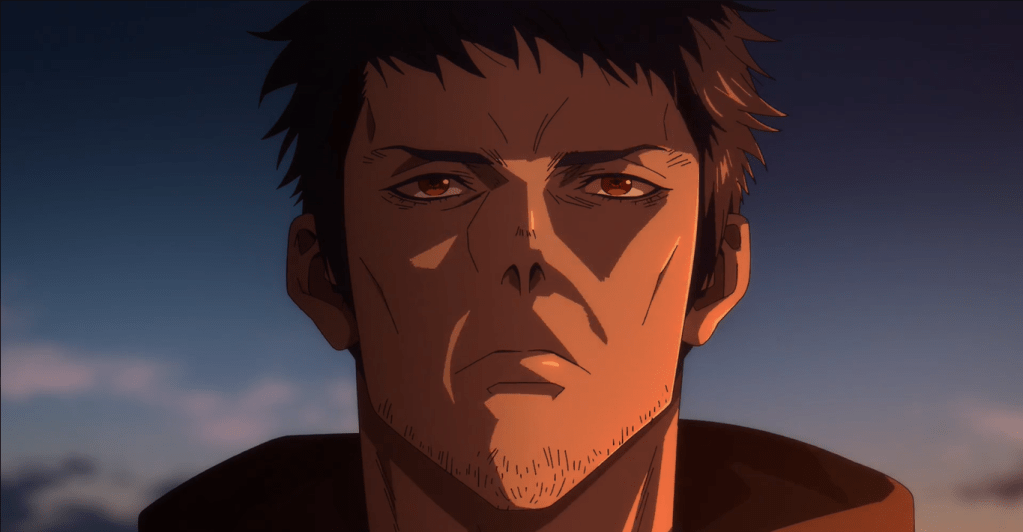
*Image Taken From Episode 1 of Ninja Kamui*
How Ninja Kamui Creates a Great Plot-Based Narrative
The creators of Ninja Kamui formulate the show’s narrative on two fronts: the world and events. They use the world primarily to express themes and organically motivate characters, while events engage, entertain, and intrigue the audience. Both combine to create the deceptively meaningful and thoroughly interesting plot that the anime builds itself on, an approach to storytelling that seems more akin to a mystery story than an action one. In fact, while still undoubtedly an action series, Ninja Kamui borrows plenty from the mystery genre, making for a paradoxically complex and simple plot. The way that paradox shows itself in both world and event is how Ninja Kamui has built up one of the best plots of the season.
World

*Image Taken from Episode 2 of Ninja Kamui*
The complex elements of Ninja Kamui manifest in the anime’s dystopian world, where the tech giant Auza and an (as of current) unnamed ninja clan working for them serve as the central factions. Auza uses illegal and immoral means to further their goals, while the ninja live, die, and kill one another in service of their great cause. The two groups cage in and control others through sheer power, and because of that, the theme of saving oneself permeates throughout the show. The dark world of Ninja Kamui makes the act necessary, incentivizing the characters to cultivate power within themselves. Weaving theme into the world is a technique often done in the classic murder mystery through certain factions, and the anime using the same technique gives a similar contemplative air. However, the theme of Ninja Kamui is inextricably linked to power, adding simplicity to saving oneself. Characters have to get strong so they can no longer be controlled, and that simple answer to the question “How does one save themselves?” naturally leads to the action scenes being sensible. With how the creators behind the anime built its world, nothing is out of place. The theme is part of the world, and the world offers a response to a question associated with the theme. The two elements of the show flow together like clockwork, paving the way for beautifully complex messages to coexist with the most dramatic of battle segments.
Events

*Image Taken from Episode 1 of Ninja Kamui*
The events are the main course of Ninja Kamui, utilizing everything set up in the world to make an incredibly fun story. The pivotal theme of saving the self shows itself in the action events, such as the introductory battle scene or Higan’s battles with Lil, where the meaningful subtext of the ninjas freeing themselves from the clan adds substance to the entertaining fights. Cutting out the heavy character work typically done in anime battles leaves room for the stunning animation to wow the audience while still delivering those thematic elements. In that same vein, moving away from lengthy characterization gives the show ample time to show off and introduce parts of the world memorably, like how the slowly unraveling mysteries regarding Auza have kept viewers on their toes for weeks. Events in Ninja Kamui never compromise on that front, always engaging and intriguing, and never dragging due to longer character arcs. As a result, the plot is a blast to consume.
The world and events of Ninja Kamui are a blend of theme and fun that even the best action series can’t quite nail. The events display and validate the complexity of the world, while the world’s simple “might makes right” feel is acceptable to the audience because of the event’s similar validation. Using that paradox of contemplative and simplistic allows the anime to make a plot as full of fun action as it is of deep meaning.
Pros and Cons of Plot-Based Storytelling
Ninja Kamui’s paradoxical approach to plot-based storytelling explains the benefits of that type of narrative, but it just as clearly communicates the flaws as well. Make no mistake, the anime is by no means perfect, and plenty of its pitfalls can be attributed to its heavy focus on plot. Understanding where it goes wrong, however, details some of the built-in faults of plot-based storytelling.
Pros
*Image Taken from Ninja Kamui’s Opening Song Vengeance by coldrain*
At their very best, plot-based tales can communicate and explore a theme in an incredibly deep way, uninhibited by the need to have complex yet consistent character. Ninja Kamui exemplifies that perfectly, as its use of the world expands on the theme from two perspectives: that of ones saving themselves from being tools and those saving themselves from participating in a corrupt system. The ninja clan and Auza, respectively, facilitate the exploration of those concepts, while associated defectors are characterized only enough to tell a meaningful story. That makes a story very powerful but simultaneously keeps it from becoming cluttered, a harmony character-based stories often cannot achieve. Ninja Kamui’s success in creating that effect in its narrative is exemplary plot-based storytelling, and other shows would be wise to emulate its use of the world themselves.

*Image Taken from Episode 2 of Ninja Kamui*
Of course, shows need to be fun too; entertainment is the bedrock of television. Without risking confusion through dense and intricate character work, plot-based narratives can often be incredibly consumable stories that entertain at a level character-based ones fail to reach. Once again, there aren’t many better examples of that than Ninja Kamui. It sells itself on top-notch animation, excellent choreography, and unique power systems, all three of which are a blast to see in motion. Even when a viewer is taken out of the experience because they misunderstand a plot element, an action scene shelves their confusion, sucking them back into a world of whizzing blades and technological marvels. Sunghoo Park and co. never slack on making the anime a joy to watch, and any good plot-based story values that entertainment factor just the same.
Cons

*Image Taken from Episode 2 of Ninja Kamui*
Unsurprisingly, in moving away from heavy character work, plot-based narratives often suffer from a lack of interesting characters that make viewers care about the story. An interesting theme and some fun, related action can certainly give viewers a good time, but retaining their attention proves difficult when a show lacks in the character department. This issue, unfortunately, is one of Ninja Kamui’s greatest blunders. Protagonist Higan is a very simple character, leaving nothing to intrigue viewers with, while his lacking personality makes him quite uninteresting outside of combat. Mike Morris suffers from the same issue to a lesser degree, having a recognizable yet hollow personality, and considering his rather simple motivation, his character lacks much depth. Viewers will just take him at face value as a good-natured and comedic officer. Key antagonists like Lil and the Auza CEO are plagued with that same hollowness to them, meaning that just like Higan and Mike, they don’t do much to entertain outside of expanding on the theme. Ninja Kamui is an incredible story, but the mediocrity of its cast seriously damages its ability to retain audience interest (though it has started to improve on the character front in the past few weeks).

*Image Taken from Episode 2 of Ninja Kamui*
The other literary sin that plot-based stories tend to commit is bad pacing. Many mystery plots are marred by mind-numbingly slow or hypersonic pacing, boring or confusing consumers, respectively. The audience is taken out of the experience as a result, erasing the suspension of disbelief and making for a less concise story. Ninja Kamui, for all of its successes, has this issue in droves. The breakneck speed that characterizes its action scenes is just as present in the quieter moments, with notable character beats being brushed over and information about the power systems merely summarized. It always feels like the audience has to piece some part of the narrative together, inferring the purpose or value of things like secret arts because the show doesn’t properly explain them. For that reason, Ninja Kamui can’t quite get some scenes to evoke as much emotion as the creators want them to; viewers just don’t have enough understanding of the narrative to feel that much. That causes its thematic elements to suffer, lessening the impact of the interesting messages the show tries to convey.
If there is one thing Ninja Kamui exemplifies about plot-based stories, it’s that the writing method has an inherent give and take to it. Focusing more on the world and events allows themes to be explored more deeply, but pacing difficulties can make those thematic elements harder to pick up for the audience. Plot-based narratives are consumable and fun in a way that character-based ones seldom achieve, but lower-quality character work risks making the tale a chore to see through till the end. Working around these inherent faults of the literary style has been an ongoing battle for the minds behind the anime, their efforts to shore up flaws causing a steady improvement in its writing quality. Any writer would do well to learn from their example, fixing and masking issues with plot-based stories while keeping the positive traits.
All this is to say that Ninja Kamui is a diamond of a story. In spite of its missteps, it overall conveys a thought-provoking, thematically rich story that can be just as entertaining as the greatest action anime in the industry. By expertly inserting the best of plot-based storytelling into the action genre, it manages to be a unique and exemplary work of animated media.
 Entertainment Analytical