There is nothing in storytelling quite like a good character relationship. Batman and the Joker, Goku and Vegeta, Miles Morales and Peter B. Parker—all of these relationships have added tension, humor, meaning, and unforgettable moments to the narratives they inhabit. Even in older literature, bonds like Romeo and Juliet enthralled audiences of the time, their romance revolutionizing literature. Without a doubt, relationships are one of the many things that can make a story great, with their versatile impact permeating throughout. No matter the medium or audience, they are always an effective storytelling tool, and Kei Urana’s Gachiakuta is legible proof of that. The ongoing action manga, in spite of its beautiful artwork and world, centers entirely around character relationships, detailing the unique benefits they offer a narrative.
Dialogue
There is one word that accurately describes the character relationships of Gachiakuta: genuine. Urana expertly portrays authentic connections between the cast members, with all relevant context factoring into how the parties interact. Her key to doing that lies in the dialogue of her work, where she leverages a duo of literary tools to create some of the most lifelike and logical conversations in manga.
Diction
Diction is the bread and butter of dialogue, responsible for getting across the basic information a character is trying to convey, but that doesn’t just mean stating expository details. Things like personality and background can be expounded with word choice, and Urana takes full advantage of that fact in Gachiakuta. The unique qualities of the cast shine through in the words they choose to say.
Case-in-point, the protagonist Rudo’s trademark vulgarity highlights both his childishness and history in an astonishingly natural way. Too inexperienced to understand romantic feelings and too rebellious to stop stealing trash, his immaturity is encapsulated in his go-to insult, “Turd brain,” while the crass and uncouth language also indicate his residing in the slums. Urana further expands on him by inserting a clear bluntness into the words he says, as seen in his first meeting with Enjin, placing Rudo’s heart right onto his sleeve, and selling his goal of finding usefulness in useless trash as authentically in character for him.
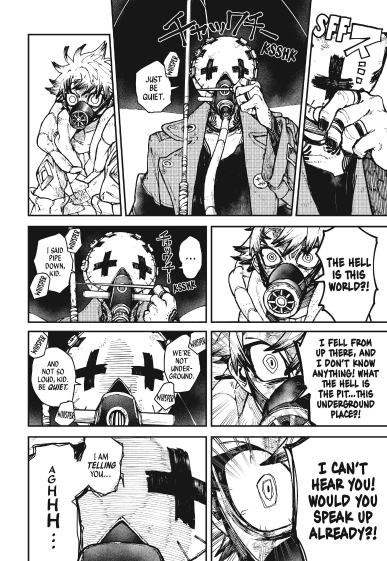
*Image is from Chapter 2 of Gachiakuta*
The effects of that kind of character-informing diction are palpable in the manga’s relationship element, which is where the genius of Rudo’s dialogue really surfaces. His straightforward and almost aggressive word choice brings out the emotion in whoever he talks to, creating loud yet open interactions (as can be seen in the above page). Because of that, his relationships are easily defined and always entertaining to see in the panels. Rudo likes Chiwa; he loves and simultaneously is annoyed by Regto; the protagonist of Gachiakuta thrives off those simple dynamics that add clarity to the cast, leave room for more isolated character moments (backstories, power reveals, etc.), and generate casual back-and-forth conversations.
Urana, using simple diction, makes her main character capable of doing all that for the story while always remaining in character, improving the narrative by leaps and bounds as a result. It isn’t just Rudo either; every soul in Gachiakuta’s world features that same carefully considered diction. Regto’s crass speech easily identifies him as Rudo’s father figure, while also leading to organic banter with the boy. Chiwa’s more proper, more refined word choice sets her apart from the story’s slum dwellers, while its familiarly casual edge paradoxically allows her to feel right at home with them. The diction of the manga consistently conveys that vital character information, a boon that grants Gachiakuta its distinctly human relationships.
Text Manipulation
Text Manipulation (as it’ll be called for this article) is anything that changes the way a reader perceives text, whether that be through bold words, unusual font choice, or other methods. Small tricks like those can add more anger, sadness, happiness, and other feelings to a character’s speech. Urana certainly understands that, as Gachiakuta employs exemplary Text Manipulation to craft its lifelike dialogue, brimming with emotion. This can be seen most strikingly in the manga’s color inversion, where the white speech bubbles and black dialogue switch colors to give a moment visual flare and intensify whatever feeling is tied to it.

*Image is from Chapter 1 of Gachiakuta*
The medium of graphic novels doesn’t contain voice acting, but readers can hear the anger in Rudo’s voice here. The imposing presentation of his words creates that wrathful, spiteful, powerful dialogue while still looking stunning from an artistic standpoint. Color inversion is capable of elevating moments to that extent when utilized properly, serving as an effective visual foundation for dramatic or climactic story beats. Gachiakuta’s use of the technique proves as much, and particularly spotlights how impactful it can be in communicating character relationships. Looking at those panels leaves no doubt in anybody’s mind; Rudo hates the masked man, the Text Manipulation makes that fact crystal clear. Their relationship is perfectly communicated by the literary technique, performing the vital duty of establishing it for readers.
On a more subtle note, notice the bold text of Rudo’s “You…”. Adding that small element dramatizes the word, impact being inserted into it. It makes the moment that much more eye-catching, engrossing readers with the distinctive dialogue. The technique is understated, but including bolded language in character speech is a brilliant design choice that generates plenty of power in the words spoken.
Urana’s Text Manipulation is nothing short of masterful, communicating emotions and relationships through the wordless exposition of how dialogue is depicted. More than that, it creates gorgeous visuals that make those relationships fun to learn about, giving a greater entertainment factor to the manga’s character dynamics.
The dialogue of Gachiakuta focuses heavily on the individual characters doing the talking, their diction revealing key details about themselves, making their conversations feel organic. Text Manipulation doubles down on that feel, communicating the emotions of the characters in a visually striking manner. While centering speech on individuals risks creating detached speech, Urana takes all the information diction and manipulation spill out and throws it in another person’s face with those very same literary techniques. The storytelling tools are always directed at someone else in the panel, and the responses of that other party make for some of the most fun and authentic back-and-forth character interactions in graphic novels. Equally interesting character relationships sprout from those interactions, featuring clearly communicated emotions that mix with the entertaining dialogue to create lifelike, genuine connections.
Body Language
According to the research done by Albert Mehrabian, 55% of communication is nonverbal; body language is just as telling as speech. Therefore, conveying the intricacies of relationships doesn’t just boil down to organically presenting how people talk, displaying their mannerisms is similarly pivotal. Urana is well aware of that though, and does an excellent job of illustrating fluid and informative motion in character interactions.
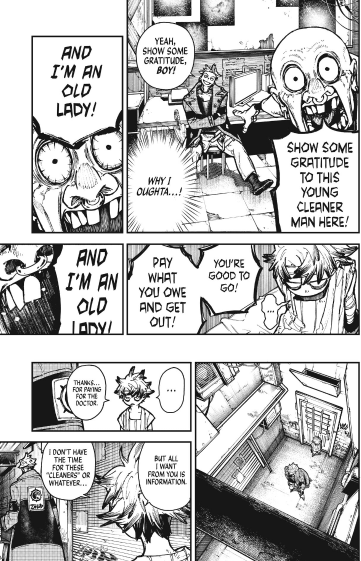
*Image is from Chapter 4 of Gachiakuta*
Take the above page as an example, and notice how the body language of the characters explains both their moods and relationships with each other. The exasperated face of the doctor as she points at Enjin, Enjin’s amused demeanor, and Rudo’s exhausted, defeated posture; all of that nonverbal communication adds life and clarity to the relationships shown in the panels. The mentor and reluctant student dynamic of Enjin and Rudo is made obvious, their body language towards each other looking casual and familiar, yet also exhausted and distant. Accurate to the context of the moment, both of them appear drained, establishing the neutral mood of both men perfectly through artwork. Even in the comedy portion, the doctor and Enjin are visibly tolerant of each other, displaying a functional working relationship. Body language is silent, but as can be seen, it can make character dynamics very lifelike while being just as informative as dialogue. Urana’s illustrations bring out that subtle impact, and Gachiakuta’s relationships feel almost animated because of them.
Lively, fun, and genuine; Gachiakuta’s character relationships are all of those things, adding depth to the cast members and entertainment to the narrative. The dialogue’s intentional usage of diction and Text Manipulation gives interactions an authentic and dramatic feel, while expertly drawn body language gives those spoken words visual life. Kei Urana’s work in this regard is astonishingly effective, her manga an exemplary piece of relationship-oriented storytelling.
 Entertainment Analytical
One response to “Gachiakuta: The Power of Character Relationships”
[…] I think about this solution in action, my article “Gachiakuta: The Power of Character Relationships” comes to mind. From an SEO standpoint, it’s the best-performing piece I’ve ever written, […]
LikeLike