
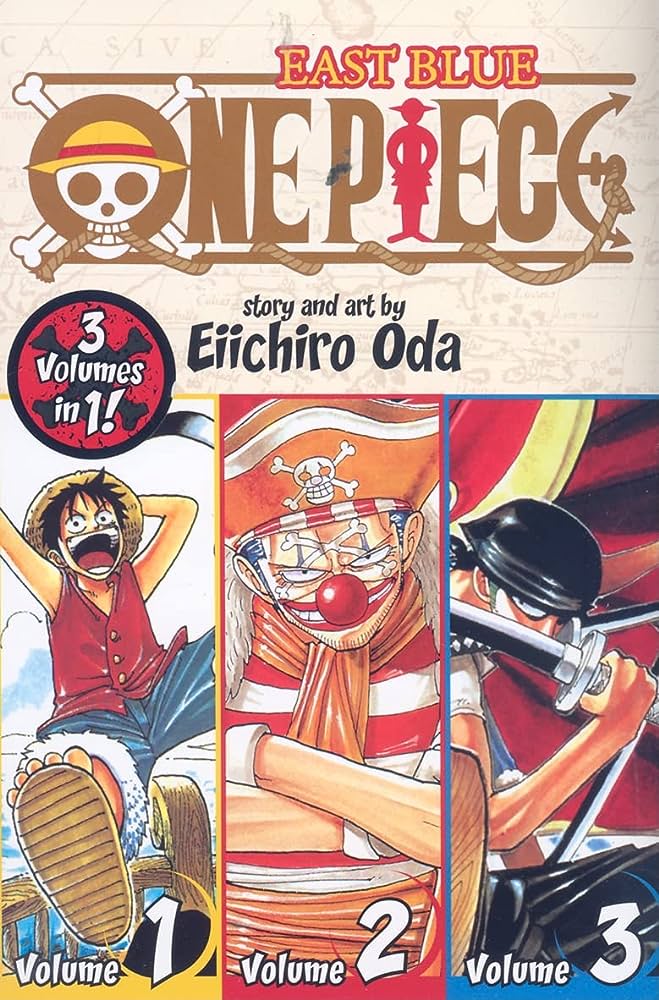
*Image from One Piece: East Blue 1-2-3 on Amazon*
To be at the top is something few will ever accomplish, and staying at the peak of that mountain for a substantial amount of time is an occurrence just as rare. It takes a lot of work, hope, and dreaming to reach that grand height. As it so happens, however, Eiichiro Oda is a dreamer, and the meteoric success of his manga series “One Piece” is a testament to that. With hundreds of millions of copies sold, One Piece is not only the best-selling manga series of all time but also the best-selling comic series of all time. In any given year, it has secured its place as the #1 most popular Shonen Jump product, and there are many reasons for that. Explaining all that contributes to One Piece’s success would take much more time than anybody would reasonably write or speak about, but the beginning is a good place to start. The East Blue Saga spans the first hundred chapters of the manga, and its powerful exploration of the concept of dreams is something to behold. It may only be a fraction of One Piece’s thousands of published chapters, but analyzing this fraction of the series could make it clear to anyone why it has stood alone on the mountaintop for so long.
Luffy and Positive Dreaming
At its core, the East Blue Saga is about Monkey D. Luffy’s adventure from the East Blue Sea to the entrance to the Grand Line. As such, all of One Piece’s themes are really established through him, and Oda did an excellent job of that. The East Blue Saga’s exploration of dreams starts with how they flesh out Luffy, and they use him particularly to establish the concept of positive dreaming, as it’ll be referred to in this article (not a coined term as far as I’m aware). Through Monkey D. Luffy’s outlook on dreaming and how he tries to achieve his dreams, that term can be clearly defined, and the layers of East Blue can be peeled back.
Monkey D. Luffy
The protagonist of One Piece himself—there’s nobody with an outlook on dreams quite like Monkey D. Luffy’s. His dream is to become the king of the pirates, a title left unused since the execution of Gold Rogers. To do so, he tasks himself with finding Roger’s legendary hidden treasure, the One Piece. Luffy’s dream is referred to as being crazy or exceedingly dangerous throughout the East Blue Saga, but he always stays diligent in pursuit of it, and he frequently announces his goal with pride and enthusiasm. That’s because, to Luffy, a dream isn’t an afterthought; it’s one’s purpose and something they should take pride in. Luffy doesn’t consider the danger of his dream or others; he simply respects them, so long as no unnecessary harm is caused by the people going after them. He views them as a part of himself and others, inextricable from the individual. With that much value placed on them, it only makes sense that he is consistently chasing his dream, and he plans to reach it through endurance and persistence. That is Luffy’s outlook on the concept of dreaming; it’s a part of the self that one should always work towards, but it should never stifle others without reason.
What is Positive Dreaming?
Through Luffy, positive dreaming is given form. If it had to be given a definition, then positive dreaming is a goal or aspiration that one at least partially uses to define themselves, adding to themselves and the world while never causing unneeded harm to either. That’s the point Oda makes through Luffy: that dreams are a part of someone, and they’re things people should always strive for. They’re beneficial to the individual and the world, and that’s why they’re so valuable. That’s one of the main themes of the East Blue Saga, but positive dreaming does have its antithesis displayed as well.
East Blue’s Antagonists and Negative Dreaming
While Oda used Luffy to define positive dreaming during East Blue, he expertly utilized interesting villains to detail the dangers of negative dreaming to readers as well. Of course, every antagonist has a different dream, but there is a thematic throughline that connects them all. By looking at their similarities, negative dreaming can be understood.
Buggy the Clown
Buggy the Clown is One Piece’s first major antagonist, and his dream is quite simple: He wants to sail the Grand Line by acquiring a map of it. This is something he tries to do mainly by stealing said map, all the while doing anything else that may help him, such as taking over Orange Town. While his goal itself is not evil or even necessarily negatively impacting the world, his means to reach it certainly are. Essentially, to Buggy, the ends justify the means, and this is a philosophy the narrative constantly shines a negative light on. That type of thinking breaks a part of what defines positive dreaming, that being that no unnecessary harm comes to others or the world, and as such, it is depicted as directly opposed to Luffy’s thinking in a way.
Arlong the Saw
Along the Saw is the last major villain of the East Blue Saga, and his dream is to one day start a Fishman empire that utilizes humans as slaves. This stems heavily from his belief that humans are the inferior race, which thematically ties him back to the real-life concept of racism, which is a big part of his character. Arlong embodies the other half of negative dreaming: subtracting from the world. See, while positive dreaming is all about adding to the world and the self, negative dreaming is adding to the self by subtracting from the world. Of course, on a basic level, a new nation would exist in the world of One Piece if Arlong were to realize his dream, but robbing any semblance of freedom away from so many is much more of a negative than a positive.
What is Negative Dreaming?
Looking at the term through the lens of Buggy and Arlong, negative dreaming is best described as a goal or ambition that is pursued in a needlessly harmful manner or that is taking away from the world in and of itself. The key to understanding how it differs from positive dreaming is in its impact on the world. Every dream adds to the self, but hurting the world and others in the process is what separates the two. That’s what makes Luffy seen as good while Buggy and Arlong are seen as bad; Luffy doesn’t immediately do anything harmful to achieve his dream, while Buggy and Arlong both do. Oda conveying this message signals that the effects of a dream, more than anything, define that dream.
The Impact of Dreams
This all just sounds like a very long way of saying harming others unnecessarily is wrong, but the East Blue isn’t so hollow. It uses the concepts of positive and negative dreaming largely to explain the impact of dreams themselves, as exemplified by all the previously mentioned characters. While they differ in plenty of ways, the thing all of Luffy, Buggy, and Arlong have in common is how they define themselves through their dreams. Their goals drive their actions, and they even seem to connect to parts of their personalities, showing just how valuable they are to those characters. By depicting dreams like this, Oda is able to spread a very powerful message: dreaming is important, and it’s a part of all of us. Our goals are part of our identity and can change us for better or worse, which is why we should value them heavily. They have such a huge impact on our lives, and East Blue details why, with how characters’ dreams alter them as people. Moreover, dreaming positively within the story positively impacts those people, while dreaming negatively leads to many characters being hated and vilified. The same can happen in real life, and that’s what makes the theme of the East Blue Saga so effective. Having such a realistic thematic throughline adds a genuine feel to the story and makes for a beautiful exploration of dreams.
 Entertainment Analytical
3 responses to “One Piece’s East Blue Saga: An Exploration Of Dreams”
This website sux
LikeLike
2 piece review when?
LikeLike
If 2 piece ever drops, then maybe
LikeLike