
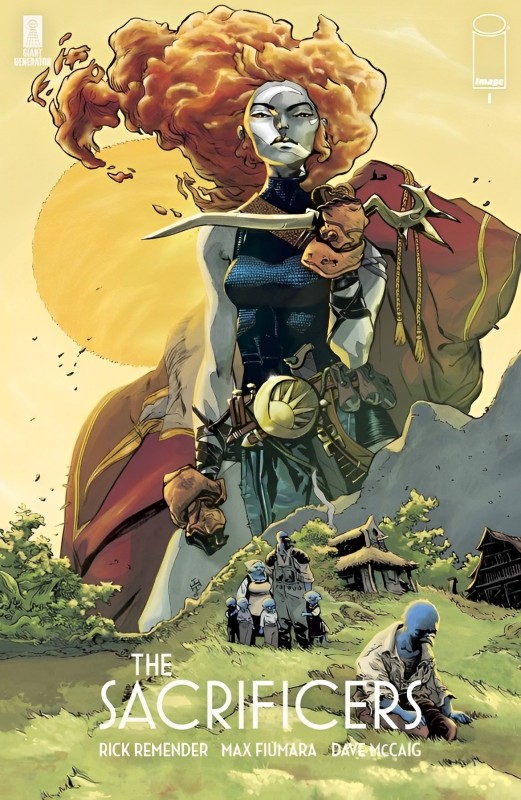
*Image taken from issue #1 of The Sacrificers.
TRIGGER WARNING: Mentions of child abuse.
*Minor Spoilers for The Sacrificers*
It’d be a tall task for any piece of media centered around anthropomorphic animals and depictions of some gods to feel grounded in reality, but that’s exactly what Rick Remender, Max Fiumara, and Dave McCaig were able to do with volume one of their new comic titled “The Sacrificers.” This fantasy/sci-fi graphic novel uses every facet of itself to tell a genuine, relatable narrative supped up with everything people like about fictional tales. Unique character designs, an interesting world, and a plot that lets someone escape from the mundanity of a day-to-day routine—The Sacrificers has all of that, but never compromises on meaningful storytelling in the process. It’s not only a joy of a read; it’s also a shining example of how to make the fantastical feel real.
Realistic and Relatable Characters
The most notable element of The Sacrificers is its character design. The comic features everything from normal people to walking and talking pigeons, and they’re all illustrated with a lifelike detail that’s equally as unsettling as it is beautiful to look at. The naturalistic look of them easily separates them from classic cartoon animals, mentally assisting readers into taking the characters seriously. Combined with realistic art is character writing that is equally true-to-life, with characters displaying emotions, beliefs, and cultures that feel like a mirror image of reality. To give just one example of this, one only needs to look at the first couple pages of The Sacrificers’ very first issue. Through these pages, readers can see a pigeon father praying before his children and wife eat a meal. It seems like a happy and wholesome start to the narrative, but after one child peeking through a window from outside is spotted (he is notably absent from the family meal), the father becomes enraged. He chases his son into a barn and brutally beats him, berating the boy for letting his mother see him that particular day and wanting attention, and calling him selfish once the beating is done. This is not only a striking and deeply disturbing beginning to the narrative; it displays all the characters involved in an incredibly genuine way. The childlike joy most of the children have upon eating their food, the serene calmness of the father, his later extreme anger, and the abused child’s fear of his situation expertly highlight how each character feels in the moment. The authentic emotion is painfully engrossing to read through, shedding light on the horrors of child abuse and giving the audience a fundamental knowledge of some character relationships. The prayer taking place before the meal is another important detail. It isn’t quite as important as the raw emotion of The Sacrificers’ first pages, but showing that little bit of belief in something greater does wonders to make the characters more believable. Lastly, the meal they’re eating is shown to be simple, not a large feast. A slab of meat, some vegetables, and what looks to be potatoes—this choice of food makes it immediately clear that the family being focused on is in the middle class of the fictional world, and that small display of their status helps establish some general culture in the narrative. The emotions, beliefs, and culture that this graphic novel starts with make its cast and world feel grounded in reality, despite its fantastical elements.
Interesting Plot
The plot of The Sacrificers is step two in making its fictional concepts feel real. In this graphic novel, a big emphasis is put on communicating aspects of the world and their deeper meanings through the plot, and it’s able to do so because of the many questions it raises. The Sacrificers isn’t a mystery comic, but the amount of unknowns it contains in volume one allows it to emulate the “What’s going on?” effect of one. This can, once again, be seen as early in the narrative as the first couple pages of the first issue. The character work done there is the primary focus, but the dinner and beating segments (as previously mentioned) contain subtle sprinkles of worldbuilding and plot explanation, raising an array of questions regarding many elements of the narrative. Who is the family praying to before dinner? What does that prayer mean? What was the father talking about throughout the abuse? All of these questions are raised and answered, not only helping with organic storytelling but also making the plot feel lifelike. It’s clear that in The Sacrificers’ fictional world, the plot is what the characters are living through, and the questions the audience asks mirror the confusion and lack of understanding the characters show regarding parts of their world. In fact, lack of knowledge is largely what moves the plot. The question of “Who is the family praying to?” quickly transitions to questions about the gods that they’re so devoted to, and those questions take form in the character of Soluna, who is the main driving force for the divine side of the narrative. This is all to say that the plot of The Sacrificers is interesting because it moves in the same way the “plot” of someone’s real life often goes. Things out of their control put them in strange situations, so they adapt, they learn, and they attempt to take back control or find a semblance of happiness. Real people deal with corruption, with fear, with frustration, and with deceit, and those things are the plot of The Sacrificers. That isn’t just storytelling; that’s reality, and The Sacrificers emulates that in order to craft a plot that sheds light on elements of the real world we all like to avoid. That makes the narrative deeply meaningful and, at times, disturbingly informative.
Themes
The traditional way of making fictional stories feel real is through themes. Themes are ideas that recur in a work of art or literature, according to Oxford Languages, and with them, authors have been able to inject meaning into even the strangest narratives. In that regard, The Sacrificers isn’t much different than many other stories, as it incorporates a multitude of themes into its characters and plot. The reasons for one’s actions and perspective are the two biggest themes the graphic novel expounds upon. Whether it be the campfire segment of issue #2, The Foreman’s anger in issue #5, or a notable reveal at the end of #3, the characters all have interesting views on the world and motives behind their thoughts and feelings. This naturally makes the narrative diverse, further helping The Sacrificers feel real.
Themes, characters, and plot—these three pillars of storytelling are things The Sacrificers expertly utilize to craft a realistic and meaningful narrative. Difficult as it may be, the authors of this graphic novel have accomplished a huge feat in making the fantastical seem grounded in reality. In doing so, they’ve not only made some great dark fantasy but also been able to tell a deeply intriguing tale.


2 responses to “The Sacrificers and Making the Fantastical Feel Real”
You have the intellect of an oversized lemon.
LikeLike
I think im in love with you
LikeLike