
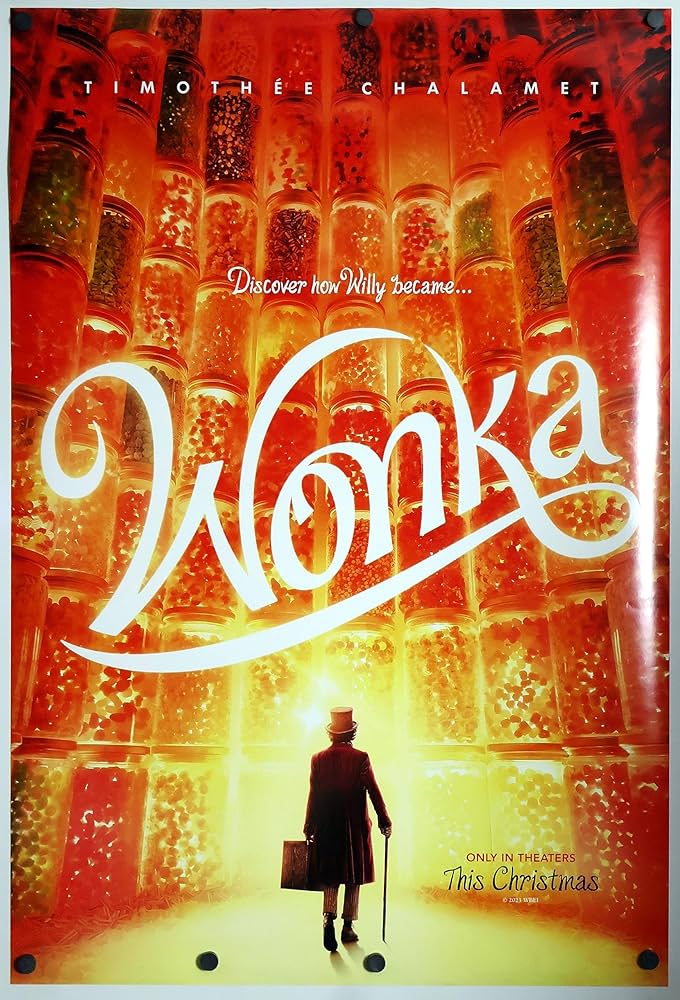
*Image taken from an Amazon posting of a poster related to the film Wonka (https://www.amazon.com/WONKA-MOVIE-POSTER-Advance-Chalamet/dp/B0CGG75JW), and this article will contain some spoilers for said film.*
Stories can be used to convey incredibly hard-hitting messages, leading to the famous saying “the pen is mightier than the sword.” Films like the classic Godzilla shed light on the horrors and massive aftereffects of nuclear warfare; video games like NieR:Automata convey the many ways beings can cultivate purpose in life and what the sudden absence of that purpose can cause; and novels like Uncle Tom’s Cabin have huge historical significance because of their honest portrayal of heinous yet at the time accepted practices. Storytelling is powerful, and much of human history makes that abundantly clear, but the art form was created just as much to entertain people as it was to inform them. Spongebob, Minecraft, Diary of a Wimpy Kid—all of these are works of storytelling meant primarily to entertain, and they do that so well they’ve been hailed as masterworks in their respective mediums. Narratives can be enjoyable and substantial in their meaning, but it is incredibly difficult for creators to actually make a tale with much of both of those qualities. Instead, many stories focus on only one of those qualities, with the other being a smaller part of the work. MCU movies, Oppenheimer, any part of Dragon Ball—plenty of great stories use that type of formula to great success, but where there is a formula, there is always something that deviates from it. Enter Wonka, the prequel movie to the beloved “Charlie and the Chocolate Factory” movie. This film finds a way to mix plenty of fun and substance into its wacky story.
Why Is Mixing Fun and Substance So Difficult?
To understand the difficulty of making a work in equal parts fun and substantial, the two terms have to be defined, at which point the issue becomes glaringly obvious. According to Oxford Languages, fun is “enjoyment, amusement, or lighthearted fun” and is something commonly associated with things like humor or low-stakes challenges (such as video games and laser tag). It’s a source of satisfaction and escapism for all, and it generally enriches lives. Substance, meanwhile, refers to the “subject matter of a text, speech, or work of art, especially as contrasted with the form or style in which it is presented.” and can be seen in the character work, theme, time period, and even the setting of a piece of media. The issue here is simple: fun helps with escapism, while substance is inextricably linked to reality. Making something fun and substantial requires finding a sweet spot between satisfying fantasy and relevant, true-to-life messages. Go too far one way and you end up with an entertaining experience that ultimately rings a bit hollow, but go too far the other and you wind up with a work that just feels scared to truly dedicate itself towards its more realistic ideas. This problem doesn’t ruin any given piece of media, as even excellent stories like Puss and Boots: The Last Wish and the aforementioned Dragon Ball universe suffer from it, but creating something without that issue is a way of making a truly unique piece of art. Wonka is proof of that.
How Wonka Combines Fun and Substance
Wonka’s unique blend of entertainment and meaning is created by combining those two concepts. It doesn’t just contain a good balance of both; it actively tries to make its fun moments substantial and its substantial moments fun. It may seem like a simple thing to do, but what the creators of Wonka were able to do with this brand of storytelling is something people will be hard-pressed to find elsewhere. Just a few examples are necessary to explain how groundbreaking this special formula can be for writers in almost any genre.
Substantial Fun
Wonka is a musical, and just like everything else in that genre, it makes it a point to tell stories and entertain through song. That said, the amount the film is able to communicate about the characters and certain thematic elements through those musical numbers is astounding. For a quick example, the first song presented in the movie is “A Hatful of Dreams,” which plays an incredibly important role in establishing the motivations and personality of the protagonist, Willy Wonka. It plays that role expertly, showing an abundance of traits in its lyrics and tone. When Willy hands a child one of his silver sovereigns in the song, his kindness within the film is established. The chorus is “I’ve got nothing to offer but my chocolate and a hatful of dreams,” and that immediately conveys that Wonka is both a hopeful and ambitious person, in addition to making his passion for chocolate clear. Furthermore, the gag of him losing more and more money throughout the song isn’t just funny; it also shows the audience that Willy is a bit naive and childish. He has big dreams, but he doesn’t understand at that point in the film that the world at large is going to make it hard to realize them. The idea of parts of the world finding ways to crush dreams is a big theme of the movie and is a very heavy subject, but A Hatful of Dreams finds a way to initially display it in a humorous manner. This one musical number is just one example of the Wonka film making fun substantial, but the many things it conveys about Willy’s personality and a theme of the film are impressive nonetheless. The movie goes on to do things just as notable with all of its songs, whether it be through the plot progression found in “Sweet Tooth” or completing Noodle’s short character arc with “For a Moment,” and by putting so much substance behind these jingles, the film is able to make truly meaningful entertainment.
Fun Substance
Wonka’s more serious beats are mostly treated with the narrative respect they deserve, but some comedic elements are slipped into these heavier moments plenty of times throughout the movie. That makes even the most substantial parts of Wonka remain entertaining, stopping the movie from ever feeling like a downer (which isn’t an inherently bad decision in storytelling, but it would’ve been a radical tone shift if Wonka had large stretches of darker writing). The most shining example of this lies in the moment when Willy’s first chocolate shop is sabotaged by the chocolate cartel. In subject matter, the moment is incredibly heavy, showing the hard work of the main cast failing to pay off. The scene thematically deals with the hardships people often face even when their dreams feel within reach, but it’s by no means depressing. The goofy, colorful hair the patrons grow as a result of the cartel’s sabotage is certainly amusing, and just that little bit of humor makes the incredibly substantial scene some fun. Another instance is the “Scrub Scrub” musical number, a catchy song that immediately follows Willy being tricked into what is effectively legal slavery. The music serves as a bit of comic relief in what would otherwise be a moment solely characterized by its portrayal of unfair and unethical business practices. Those two instances, and many others, shine a light on how Wonka uses funny visuals and song to make even its most substantial aspects genuinely entertaining.
Substantial fun and fun substance; combining the two produces what Wonka is. Light yet meaningful, childish but with hints of maturity, and duality like that is something even the best of films fail to produce. Wonka isn’t so heavy of a movie that you wouldn’t want to watch it on a boring Saturday night, but it has real messages that are conveyed in such a stylish and entertaining way that they’re easy to swallow. It’s a simple motion picture if someone just wants it to be a comedy, but it can be more than that when one reads in between the lines, and that’s because of its formula of storytelling. That method is something that almost any film can use successfully, even if it is tricky to implement. What the many minds behind Wonka have done is by no means an elementary task, but the quality of the film speaks volumes about the impact of mixing fun with substance.
 Entertainment Analytical
One response to “Wonka: Mixing Fun with Substance”
No way why he look like a slippery gecko
LikeLike