
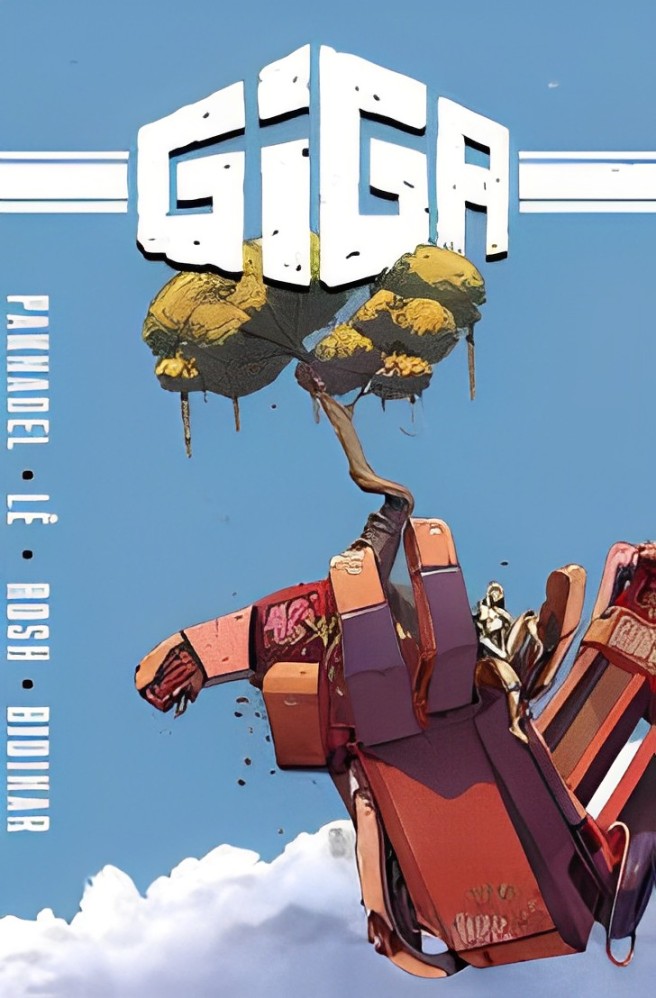
*Image taken from an Amazon listing of Giga: The Complete Series (https://www.amazon.com/Giga-Complete-Alex-Paknadel/dp/1939424887), Article Contains Spoilers for all of Giga*
What are the most valuable things in life? Even if one hasn’t phrased it in that exact manner, everyone on Earth has surely asked themselves that at least once, and for good reason. Value is an all-encompassing concept, stretching beyond monetary value and into the abstract, with even things like love having a certain amount of it. Understanding the value of things is thus a fundamental aspect of life, something worthy of thought, and there’s a certain story that gives those thoughts form. Author Alex Paknadel and illustrator John Lê’s graphic novel Giga explores the value of people and truth through its characters and world. Its thematic depth makes for a very introspective tale, and the giant robots certainly have their charms too.
The World
The deeper themes of Giga are built into the fabric of its world, with the comic displaying those ideas with mysterious entities and literature alike. Using the backdrop of religion, a fully-fledged world is constructed within its panels, highlighting the value of truth. The titular Gigas and the ethereal Book of Assembly are the author’s weapons of choice to give those concepts form. Paknadel’s masterful writing gives both of them relevance and meaning in the narrative.
Giga
From the very first pages of the graphic novel, the importance of Gigas is made crystal clear. The entities this comic is named after are gigantic machines within its world, with humanity deifying and living in them but still not truly understanding them. Their mysterious nature is the driving force of the plot, but more than that, the mysteries of the Gigas are the thematic cornerstone of the graphic novel. The value of truth is consistently questioned in relation to these machines, as more and more people die or are harmed in the pursuit of understanding them. Is this amount of loss worthwhile? How important is the nature of the Gigas? Questions like these are presented to the audience because of the titular robots, and the comic’s biggest moments are inextricably tied to them. Through the Giga and their impact on the world, Paknadel emphasizes that truth and the pursuit of it are anything but frivolous, while also highlighting the cost of gaining true understanding.
The Book of Assembly
The Book of Assembly is the religious text of Giga’s world, serving as the foundation of the religion surrounding the titular machines. The many verses it contains stylize the panels of Giga, giving them a serene feel and making many plot points believable. From a literary standpoint, the book is almost like glue, keeping the world and its characters sensible, no matter how abstract the story gets. Furthermore, the Book of Assembly also holds thematic value in Giga, as people’s relationships to it symbolize the real-world occurrence of religious texts being perverted because of false interpretations or simple corruption. This is best exemplified by Father Crowquill, who is seen disrespecting it in spite of his status being directly connected to his knowledge of the text. That powerful theme of truth that the Giga are connected to is thus given value in the narrative because of the book’s perversion. The Book of Assembly, both for its interpretive content and its usage within the comic, spreads the message to understand things for oneself across all of Giga.
Gigas and the Book of Assembly combine to frame the world of the graphic novel they inhabit, making it infinitely interesting and meaningful. These two things allow themes and messages to permeate throughout the comic, even in its quietest moments. Their effect on the quality of the story cannot be understated; what Paknadel did with them is exemplary in terms of worldbuilding and weaving themes into a story.
Characters
The characters of Giga are much less dramatized than others in the graphic novel medium and the fantasy genre as a whole. Their more realistic nature weaves more nuance into their beliefs, actions, and feelings, which help the story dive into the finer details of the human condition. This is seen most in the main protagonist and antagonist of the comic: Evan and Aiko. Both of them are microcosms of world views people often see in reality.
Evan
Evan is the protagonist of Giga, a crippled but incredibly talented engineer who holds no religious devotion for the Giga, instead living a quieter life away from his old associates in the order (a theocratic group that runs most of Giga’s society). His journey throughout the narrative is one driven forward by various relationships, showing how much the character values others despite his colder disposition. Whether it be Mason, Aiko, or Laurel, he’s always assisting someone or some group, whether he wants to or not. Evan’s character at large represents the idea that people are just as, if not more, important than a great truth. To him, people give him purpose, and living a quiet life with friends and loved ones is perfectly satisfying. By writing the protagonist like this, Paknadel is able to illustrate the high value of connection and love.
Aiko
Aiko is Giga’s main antagonist, aiming to see inside the mind of the legendary Red King (who is a Giga) in order to gain a true understanding of the titular machines. Trying to do such a thing to the religious icons of the story’s society is deemed disgusting in its world, so she resorts to much more sinister tactics in order to reach her ends. Lives are sacrificed, and many more are damaged, all so she can satisfy her longing to know, manipulating many to do so. Was it worth it? That’s up to the reader to decide, but Aiko’s character symbolizes something very powerful nonetheless. The further one digs for the truth, the more they have to let go of, and sometimes burn, what the truth currently is. In doing that, Aiko undoubtedly became a terrible person, although her more warm and understanding personality may lead one to think otherwise. The dilemma of her actions, their effect on her, and their effect on others make her an infinitely interesting character that brings into question the value of the truth.
Both characters personify different viewpoints on the value of truth, with Evan thinking people are more important than the truth and Aiko believing nothing is more important. The narrative shows the positives and negatives of both and leaves it up to the reader to consider if either is correct or if perhaps a third road is more beneficial. Giga writing its two most key figures in this manner sneaks the themes and messages they embody into almost every crevice of the comic, giving it its introspective feel and making for an excellent narrative.
Art
Lastly, illustrator John Lê’s work on Giga’s art is able to make the comic look realistic while still spotlighting facial expressions and sci-fi elements. This allows the deeper ideas of the story to remain grounded in life-like visuals, making the messages it conveys feel more serious. The facial expressions getting extra detail and focus in the illustrations leave almost no confusion about the emotions of characters panel-to-panel, keeping the cast, their thoughts, and their beliefs consistent within the narrative. Additionally, giving sci-fi elements like the Gigas or highly advanced tech attention in the drawings gives them a “wow factor” that keeps the graphic novel’s meaningful story still simply entertaining. Lê did a phenomenal job with Giga’s art style, utilizing realism and select artistic focus to make jaw-dropping illustrations that enhance many elements of the comic.
Giga, in almost every aspect, ties back to its themes of people, truth, and the value of those two concepts in the world. It uses its sci-fi setting to explore the value and cost of the truth, its protagonist and antagonist to shed light on various viewpoints, and its art to magnify its most important ideas. Paknadel and Lê’s work on this comic makes for one of the most deeply thematic stories anyone could find, bringing up relevant topics and leaving what is correct up to interpretation. Walking away from the graphic novel, readers are sure to reflect on the themes of the narrative, both because of their powerful presentation and their real-world importance.


One response to “Giga: The Value of People, The Value of the Truth”
10/10 read. My only gripe is the one scene with the worms. If you know you know.
LikeLike